
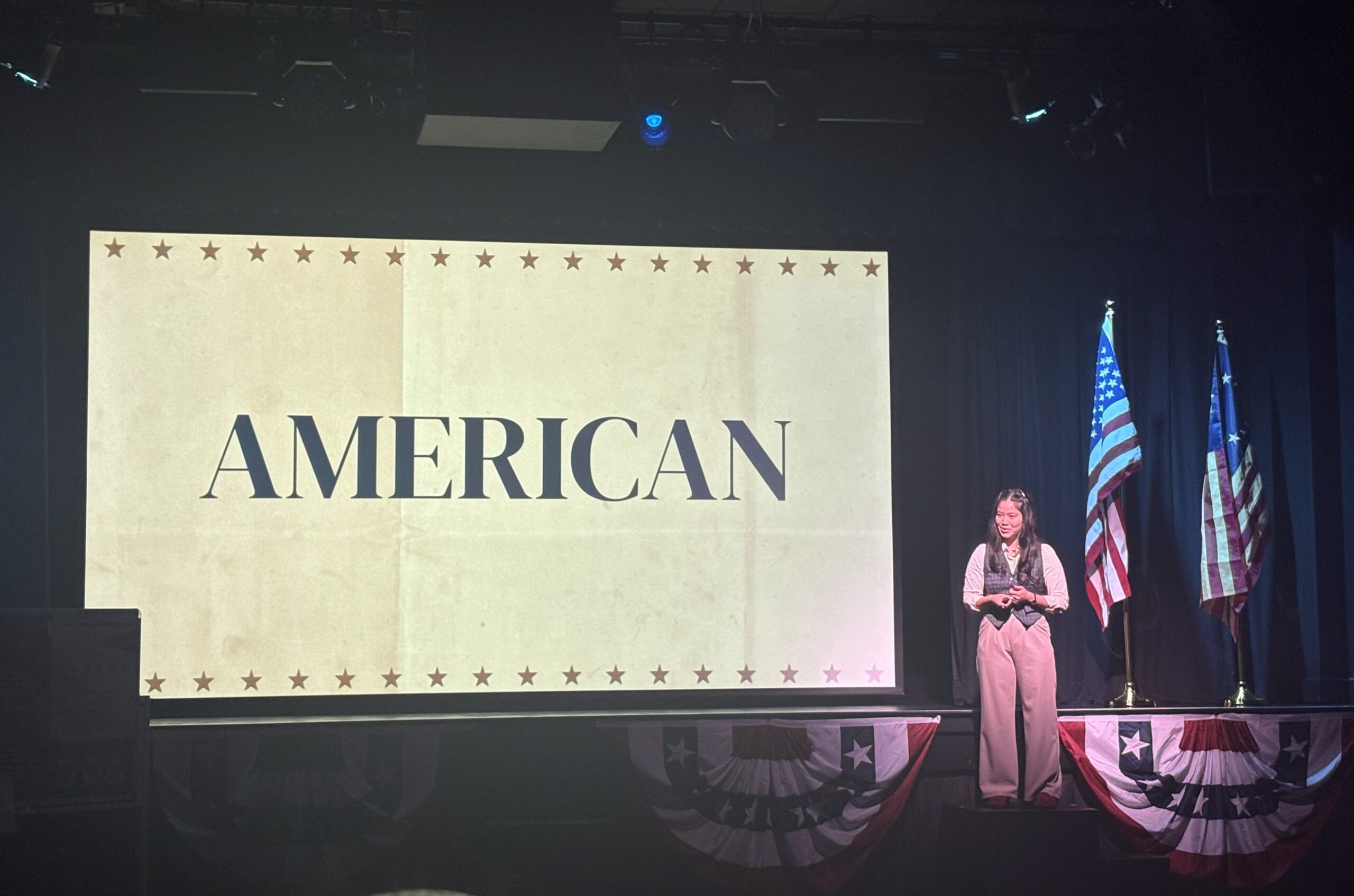
On April 16, I had the pleasure of attending an invited preview performance of Prima Theatre’s newest comedy, “The Complete History of America [Abridged].” On Prima’s website, they advertise “The Complete History” as “a clever, high octane comedy,” an entirely fitting description for the 90-minute long show.
“The Complete History” stars Joshua William Green, Mikey LoBalsamo and Aubrie-Mei Rubel, who together use props, voices, expressions and gestures to present a truly hilarious version of American history. They present this history in a series of ridiculous scenes that highlight the ironies and hypocrisies of the development of America. First, they enact a scene in which Amerigo Vespucci (LoBalsamo) argues with his wife (Green). This sidesplitting scene brilliantly introduces a trend throughout the production: the depiction of the history of America in an ironic and unserious way that reasonably undermines fatalistic narratives celebrated by the American historical tradition. In other words, “The Complete History” gets its completeness not from the breadth of its scope, but from its rejection of the reductive mythicization or romanticization of American history.
The actors gave “The Complete History” its comedic brilliance. All three impressed the audience with their mastery over expressions and gestures. There were several instances in the performance when the actors recited long lines with comedically-complicated words so perfectly that the audience could not help but applaud; LoBalsamo was the first in the performance to recite such a tongue-twister, flawlessly pronouncing (and almost rapping) a series of difficult biological terms, and the audience whooped and cheered him on. All three actors also display incredible capabilities in singing and manipulating their voices; if the comedy itself doesn’t interest you, consider seeing “The Complete History” just to witness the wonderful stage talent of Green, Balsamo and Rubel.
In addition to delivering laughs, the production also encourages the audience to consider questions particularly relevant in modern humanities studies. Early in the production, Betsy Ross (Rubel) presents hysterically-outlandish options for the first flag of the United States. In doing so she explains the symbols on each flag. Of course, this scene makes the audience laugh, but it also encourages the audience to laugh about the interpretation of symbols, a task often addressed in the humanities. As a student of English Literature, I also found Rubel’s close-reading of the word “American” funny in a very personal way. In addition to poking fun at mythicized versions of American history, the production also seems to make fun of ways of analyzing history – if you ever find yourself frustrated with scholarly analysis, watching “The Complete History” might help you feel better.
American history is often considered from a partisan perspective, and “The Complete History” certainly makes fun of America’s struggle with establishing an “objective” perspective. The production pokes fun at both Democrats and Republicans; Green, for example, plays an incredibly unbothered Barack Obama, and LoBalsamo acts as a clueless Ronald Reagan. Rather than making a futile attempt to avoid offending anyone, the production spreads its critical focus across many groups so that its jokes are without any obvious spite or grudge.
My experience at the Prima was incredible. The black box environment made the show feel intimate, and the actors (who often approached and jokingly heckled the audience) certainly took advantage of that intimacy. Go see Prima Theatre’s “The Complete History of America [Abridged],” which will be showing until May 3. If you see “The Complete History” on Thursday, April 23 or Saturday, April 25, you can use the following student discount to purchase tickets for just $25: FM25.
Charlie Burns is the Editorials Editor. His email is cburns1@fandm.edu.