
The Red Zone Campaign on Franklin & Marshall’s (F&M) campus has concluded, but the fight to spread awareness and the efforts to engage students in violence prevention never stops.
The Red Zone is a period of time from the beginning of the fall semester to the start of Thanksgiving break, where the majority of campus sexual assaults happen. There are a lot of different factors that contribute to why the Red Zone exists; however, the most notable explanation is that college represents “A culture that encourages drinking and hooking-up simultaneously, treating sex as a conquest,” in regards to students entering college having easier access to drugs and alcohol, adjusting to the new party culture and social situations. Another issue is a general point about college programs where there is “a lack of effective prevention and education programs both before and after entering college.”
It is hard to know the true scope of sexual violence, as many survivors don’t report or disclose that they have been sexually assaulted. Therefore, the Shatter the Red Zone campaign is intrinsically designed and dedicated to ‘shatter’ the silence around college sexual violence, specifically raising awareness of where it is most prevalent. On F&M’s campus itself, the Office of Student Wellness Education and Violence Prevention (WEVP) has made great efforts in advertising this campaign, such as posting yard signs with the words “We are in The Red Zone” across the main parts of campus, frequent tabling efforts by the Peer Health Educators to engage with students about the message and goals of the campaign itself, and spreading awareness on Instagram with information on prevention, resources, support for survivors, and more.
As a Peer Health Educator myself, I have had a great experience contributing to outreach efforts about the Shatter the Red Zone campaign. My fellow team members and I spent weeks tabling for this campaign, both inside and outside of the College Center (CC). These tabling efforts include me and other WEVP members educating others about what the Red Zone is and how it affects our campus. Last but certainly not least, we also ran an engaging trivia activity where people spun the wheel to answer a question related to education and preventative measures. The color they landed on corresponded to the type of question they would answer. These questions ranged from “What percentage of sexual assaults on college campuses go unreported?” and “What if someone says ‘maybe’ or ‘I don’t know’ when you ask for consent?” and so on.
Throughout our entire campaign, we’ve had a total of 122 students approach our tabling efforts. Below is the survey data provided by WEVP regarding the campaign’s results among the student body, with the scale ranging from 1 (disagree) to 2 (neutral) and 3 (agree). The continuation of this article follows these figures.
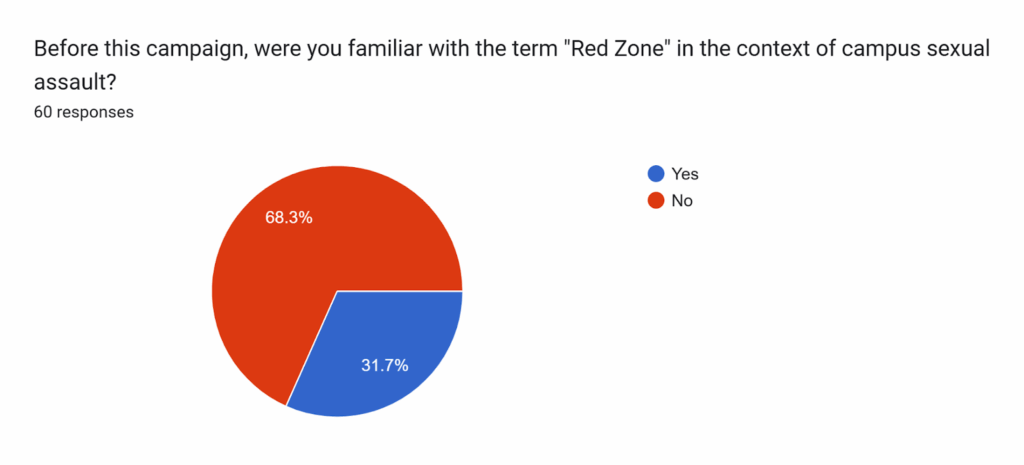
WEVP Pie chart on familiarity with the term “Red Zone.”
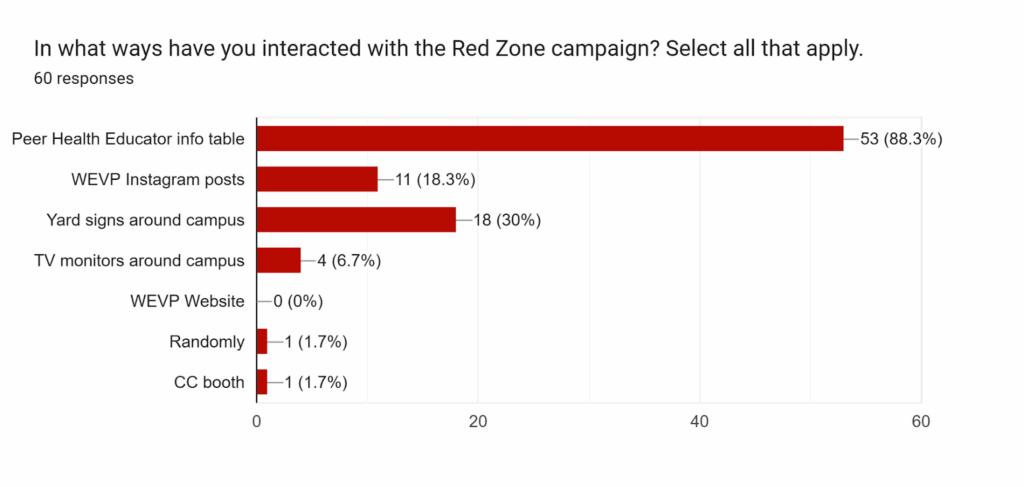
WEVP Bar chart on interaction with the Red Zone campaign.
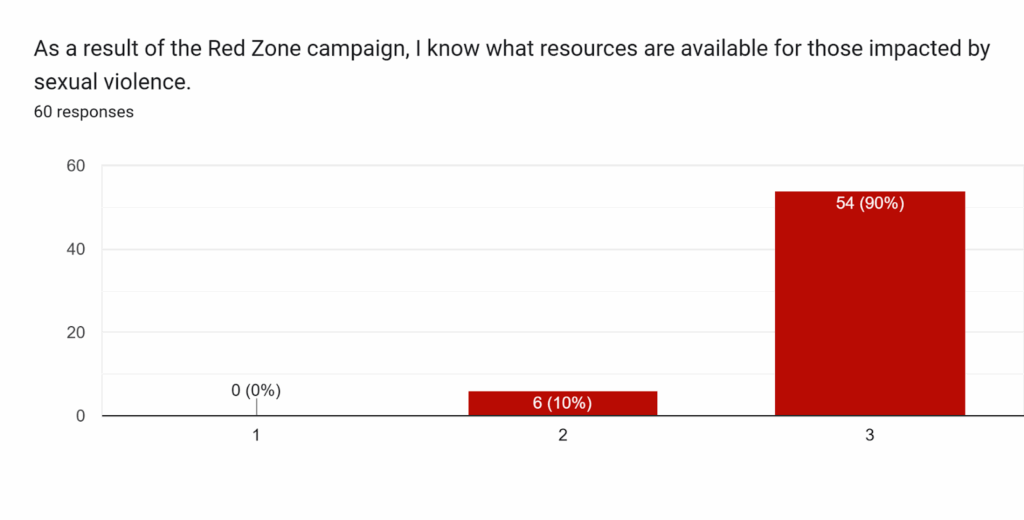
WEVP Histogram chart about knowledge on available resources for those impacted by sexual violence.
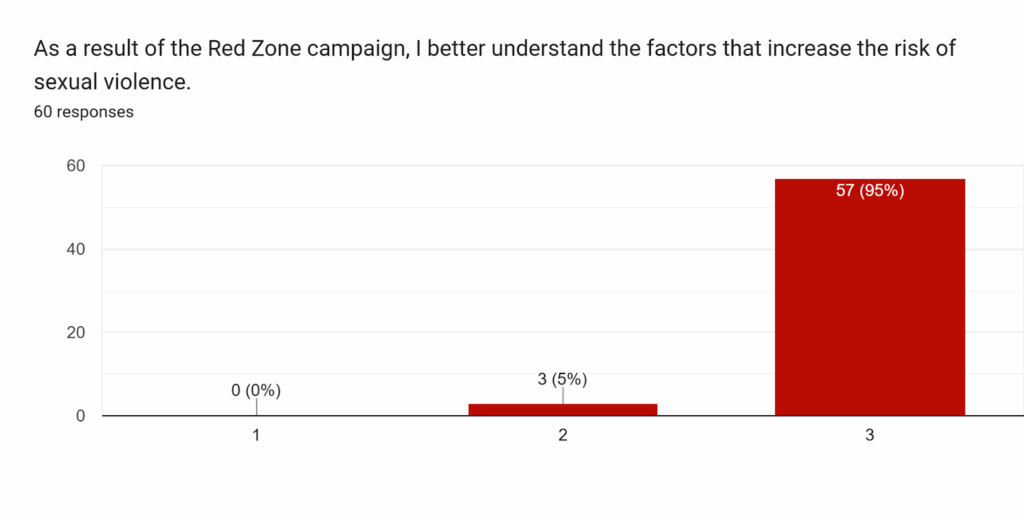
WEVP Histogram chart about knowledge on understanding factors that increase the risk of sexual violence.
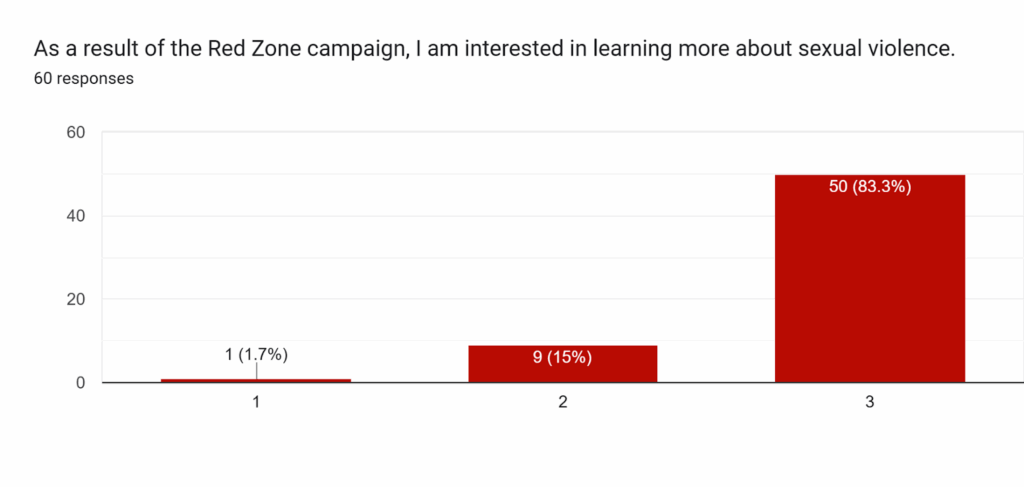
WEVP Histogram chart about interest in learning more about topics related to sexual violence.
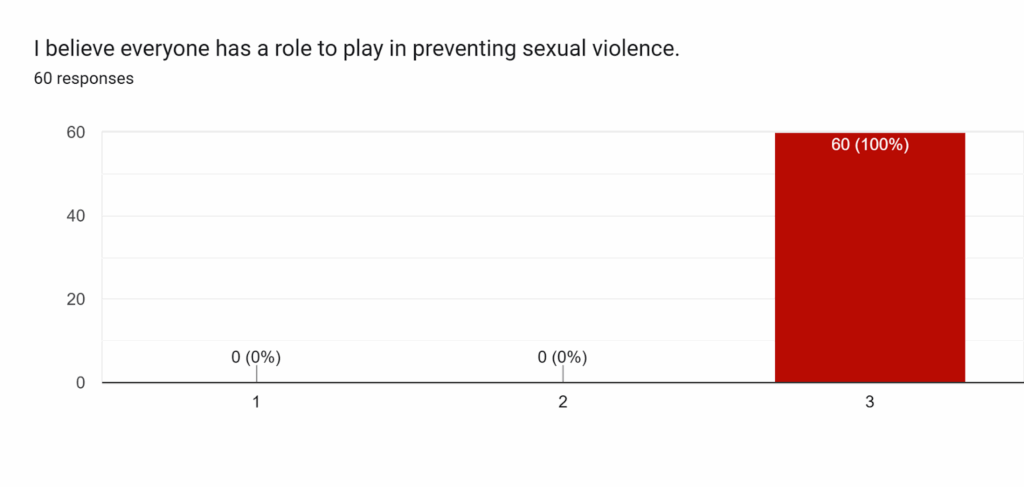
WEVP Histogram chart about belief in preventing sexual violence.
I have loved and appreciated the people who have come up to our table to learn more about the Red Zone. It was a joy to see people so passionate and open to answer questions related to sexual violence education and prevention (and to also get a prize by answering a question correctly)! Having an open mind to learn is helpful in itself. Not only is the Red Zone campaign founded on spreading awareness, but also on dispelling outdated ideas about how sexual violence cases are conducted on campus, closely focusing on the elimination of rape culture and victim-blaming. It is also integral to amplify the importance of education practices, such as not only running campaigns but also counseling and media efforts to shape the social and physical environment.
All of this in consideration leaves me with my last point: Education is an essential key to prevention. By spreading awareness and knowledge on sexual violence and wellness topics, we can get closer to shaping a safer and more respectful environment on our campus. Additionally, these efforts help peers build skills to recognize potential signs of harm and intervene safely and effectively. Raising awareness about resources and reporting also helps normalize seeking help and increase the likelihood that people who cause harm will be held accountable.
The WEVP website provides resources and information for anyone who may be experiencing sexual or relationship violence at any stage. The WEVP office is also open to answering any questions or concerns, and one of these avenues is meeting with our student Peer Health Educators or requesting a WEVP training or program. The office is located on the first floor of Harris 001. Another avenue is to contact the office at wevp@fandm.edu, as well as follow us on Instagram @wevp_fandm for the latest WEVP news and updates.
Senior Gab Neal is the Managing Editor. Her email is gneal@fandm.edu.